Using a Loan Calculator for Your Next Major Home Project
Plan Your Project Payment Before You Commit
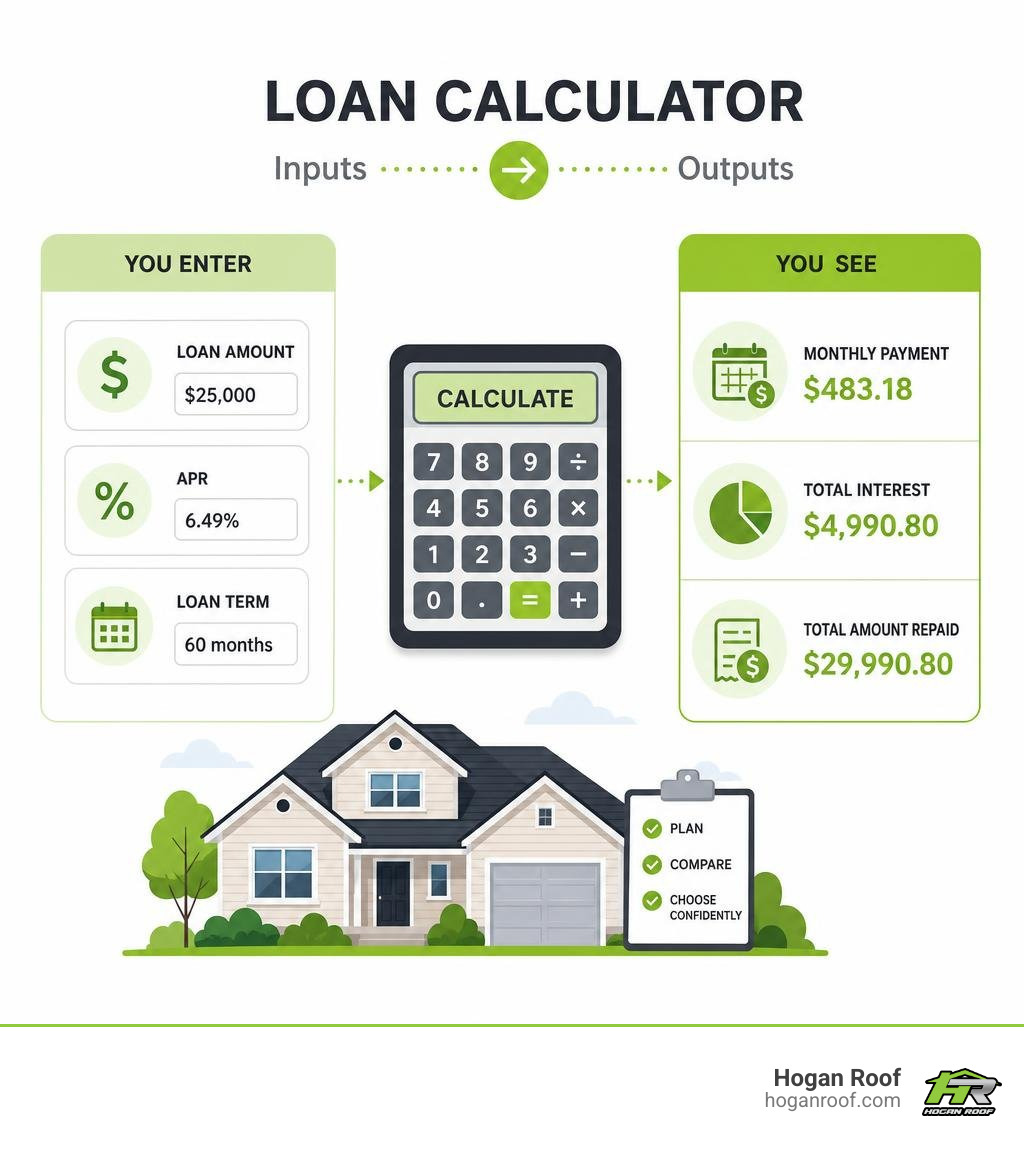
Use a loan calculator before choosing financing for a roof, siding, or gutter project. Enter the amount you plan to borrow, the APR, and the repayment term. You will see your estimated monthly payment, total interest, and total amount repaid.
This gives you a simple way to compare options:
- Set a monthly payment that fits your budget.
- Test a shorter and longer loan term.
- Compare total interest, not just the payment.
- Check whether fees change the APR.
- Ask whether extra payments go directly toward principal.
A lower payment can look appealing, but it often means a longer term and more interest overall. Knowing the numbers before you sign can make it easier to plan a major repair without adding avoidable costs.
I am Bill Hogan, owner of Hogan Roof, and I have spent more than 20 years helping NY/NJ/CT homeowners and business owners plan essential exterior projects. A loan calculator can help you connect a project budget with a payment plan before moving forward with roofing, siding, or gutter work.
Loan calculator vocab to learn:
How a Loan Calculator Works for Home Improvement Financing
When planning a major renovation, focusing solely on the contractor's bottom line tells only half the story. The total cost of an installed system depends heavily on how you finance it. A calculator solves this by modeling how loan principal, repayment duration, and interest rates interact over time.
Most digital calculation tools operate bidirectionally. You can enter a target borrowing amount based on our transparent pricing to determine your required monthly installment, or enter an affordable monthly budget ceiling to reverse-calculate your maximum borrowing power.
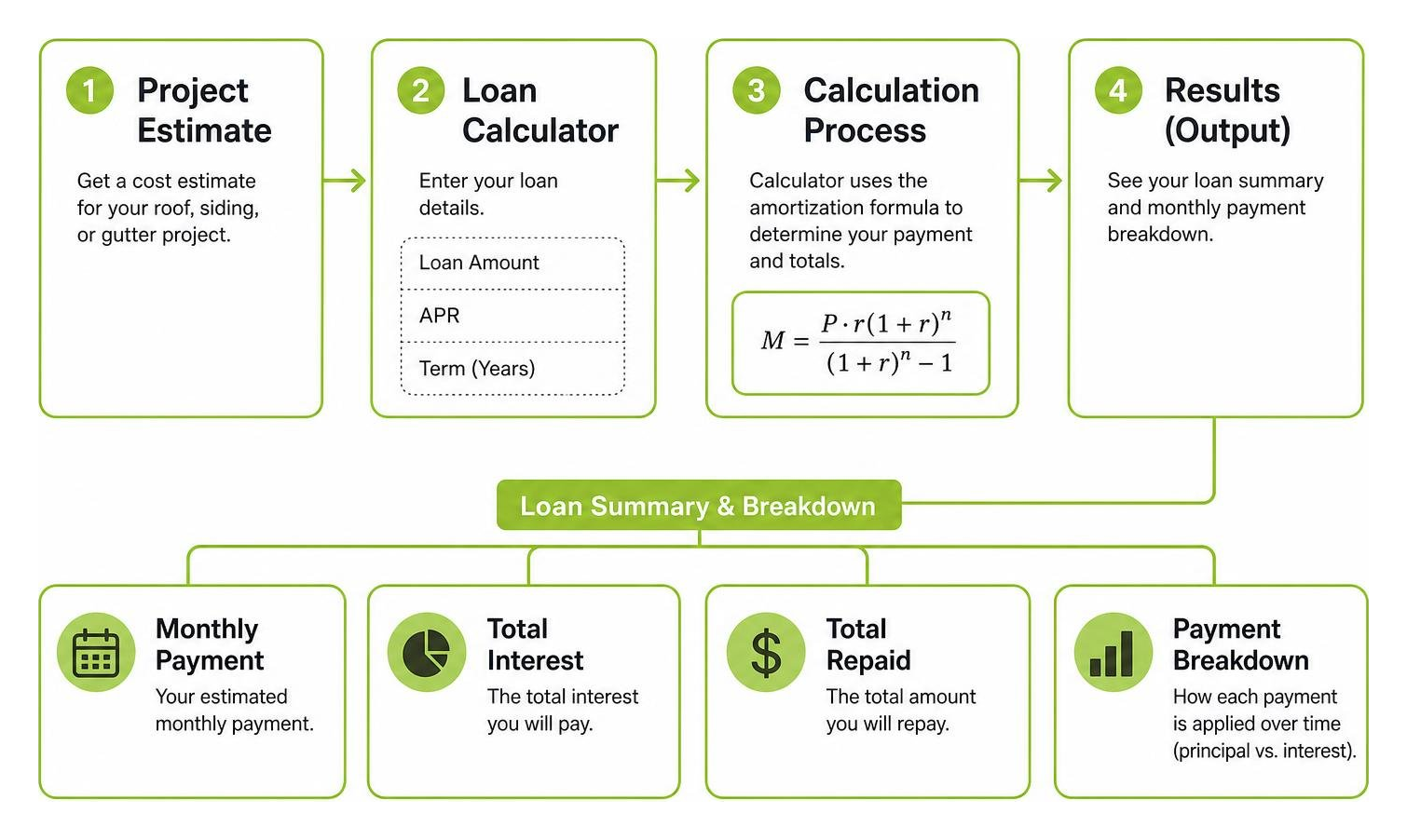
Understanding the Core Amortization Formula
Standard consumer installment loans rely on the fixed actuarial amortization formula to calculate equal periodic payments ($M$):
$$M = \frac{P \cdot r(1 + r)^n}{(1 + r)^n - 1}$$
Where:
- $P$ = Principal loan amount
- $r$ = Periodic interest rate (annual nominal rate divided by the number of payment periods per year, typically 12)
- $n$ = Total number of scheduled payments (loan term in years multiplied by 12)
This mathematical relationship ensures your payment remains identical each month while dynamically shifting the internal allocation. Early on, the periodic rate applies to a large balance, sending most of your cash toward interest charges. As the principal drops, interest shrinks, and principal reduction accelerates. You can explore amortization formula and interest calculation mechanics to see the step-by-step mathematical derivations behind these payment curves.
Loan Structures: Amortized Loans, Deferred Payment Loans, and Bonds
Not every financial product follows standard installment amortization. Understanding alternative structures protects you from unexpected cash crunches:
- Amortized Installment Loans: Uniform periodic payments covering interest and principal until the balance hits zero at maturity. This represents the vast majority of personal, auto, and home improvement loans.
- Deferred Payment Loans: Payments are suspended during an introductory period or project phase. However, compound interest continues to accrue and capitalize onto the principal balance, requiring a massive single lump-sum payout or sharply elevated installments at loan maturity.
- Bonds and Zero-Coupon Structures: Primarily used in commercial finance, zero-coupon structures are issued at a deep discount to their face value. The borrower receives discounted initial proceeds and pays back a predetermined lump sum at maturity, with all accumulated interest bundled into the final payoff.
Key Factors That Shape Your Monthly Payment and Total Loan Cost

Three primary levers dictate your financing costs: your borrowed principal, your interest rate, and your term length. If you are budgeting for a roof replacement, generating an Instant Roof Quote provides a reliable baseline principal to test against various interest brackets.
Nominal Interest Rate vs. Annual Percentage Rate (APR)
Borrowers frequently confuse nominal interest rates with the Annual Percentage Rate (APR). The nominal interest rate represents the direct baseline percentage charged on the outstanding balance.
Under the Truth in Lending Act (TILA) and federal Regulation Z disclosures, lenders must state the APR, which combines the nominal rate with mandatory upfront charges, such as lender origination fees, administrative charges, and closing points.
For instance, borrowing $200,000 over 30 years at a nominal rate of 6.5% carries a baseline principal and interest payment of $1,264.14. If the lender tacks on $4,000 in upfront origination fees financed into the balance, your true APR climbs to 6.695%—adding roughly 0.2 percentage points of hidden long-term expense. In comparison, federal student loans charge fixed upfront origination fees of 1.057% on undergraduate direct loans (at a 6.53% rate for 2024–2025) and 4.228% on Direct PLUS loans (at 9.08%), illustrating how processing fees increase total debt obligations across lending categories.
Secured vs. Unsecured Financing for Major Renovations
Home improvement loans typically fall into secured or unsecured categories:
- Secured Loans (Home Equity Loans & HELOCs): Backed by your property as collateral. Because the lender places a legal lien against your home, default risk is lower, resulting in lower interest rates. However, defaulting risks foreclosure.
- Unsecured Loans (Personal Home Improvement Loans): Require no collateral or property liens. Lenders evaluate your application based on the Five C's of Credit : Character (credit history and track record), Capacity (debt-to-income ratio), Capital (liquid savings), Collateral (non-applicable here), and Conditions (loan purpose and broader market stability).
Unsecured personal loans provide fast approvals and protect home equity, but they carry higher interest rates depending on credit profile brackets:
| Credit Tier | FICO Range | Typical Unsecured APR Range |
|---|---|---|
| Prime / Excellent | 720–850 | 7.0% – 14.0% |
| Near-Prime / Good | 660–719 | 12.0% – 20.0% |
| Subprime / Fair | 580–659 | 20.0% – 36.0% |
Reading an Amortization Schedule and Strategic Payoff Methods
An amortization schedule provides a period-by-period roadmap of your loan. It lists each payment number, payment date, the split between principal and interest, any applied prepayments, and the remaining loan balance.
A critical milestone on any schedule is the crossover point —the exact month where the portion of your payment applied toward principal exceeds the portion consumed by interest. On long-term loans, this crossover takes years to occur. For example, on a 30-year fixed loan at 6.0% interest, the crossover point does not arrive until roughly year 18. If your interest rate exceeds 7.0% over 30 years, cumulative interest charges will actually exceed the original principal borrowed.
| Repayment Scenario ($250,000 at 6.0% for 30 Years) | Monthly Payment | Payoff Timeline | Total Interest Paid | Total Interest Savings |
|---|---|---|---|---|
| Standard Monthly Schedule | $1,498.88 | 30.0 Years | $289,595 | $0 |
| Biweekly Payment Plan | $749.44 (every 2 weeks) | 24.5 Years | $226,595 | ~$63,000 |
| Standard Monthly + $200 Extra Principal | $1,698.88 | 22.2 Years | $203,595 | ~$86,000 |
Accelerating Payoff with an Extra Payment Loan Calculator
Because interest accrues directly against the outstanding balance, extra principal payments applied early in the repayment cycle produce massive compounding savings.
Consider a $25,000 personal loan at an 11.5% APR over a 5-year term:
- Baseline monthly payment: $549.82
- Total interest paid: $7,989 (roughly 32% of the original principal)
If you stretch that same $25,000 loan to a 7-year term, your monthly payment drops by approximately 21% to $435.00, but your total interest surges by $3,523 to $11,512. Conversely, taking a $20,000 5-year loan at 4.5% interest and adding $100 per month in extra principal payments saves approximately $500 in interest and eliminates an entire year of payments.
Before making prepayments, always contact your loan servicer. Verify that your loan contract contains no prepayment penalties, and ensure extra funds are designated explicitly as "principal curtailment" rather than advancing the next calendar due date.
Mastering Biweekly Payments with a Loan Calculator
A biweekly schedule involves paying half of your regular monthly payment every two weeks. Because there are 52 weeks in a calendar year, you make 26 half-payments, which equals 13 full monthly payments annually.
That single extra payment per year goes 100% toward principal reduction without disrupting monthly cash flow. As demonstrated in our comparison table, applying a biweekly strategy to a $250,000 30-year loan at 6.0% eliminates roughly $63,000 in interest and trims 5.5 years off the payoff date. You can utilize comprehensive loan calculations and payment modeling to test custom biweekly schedules, view advanced APR scenarios with fees, and download full amortization reports.
How to Compare Financing Options for Your Project

When reviewing financing proposals from contractors or lenders, evaluating offers side-by-side reveals substantial cost differences across terms:
- Mortgage Terms: On a $350,000 balance at 6.5%, a 20-year term requires $2,609.51 per month with $276,281.43 in total interest. A 30-year term lowers the monthly obligation to $2,212.24 but inflates total interest to $446,405.71—costing over $170,000 more in lifetime interest.
- Auto Financing: A $35,000 vehicle loan at 5.0% costs $1,048.98 monthly with $2,763.33 total interest on a 3-year term, compared to $660.49 monthly with $4,629.59 total interest on a 5-year term.
- Debt Consolidation: Consolidating $10,000 at 12.5% over 3 years requires $334.54 per month ($2,043.31 interest) versus $224.98 over 5 years ($3,498.76 interest), delivering nearly $1,500 in direct savings with the shorter repayment horizon.
When shopping for rates, request prequalifications that use soft credit inquiries, which do not harm your credit score. Once you select a lender, they will run a formal hard inquiry. Keep your debt-to-income (DTI) ratio in check: lenders typically look for a front-end housing DTI under 28% and a total back-end DTI (all recurring monthly debt payments divided by gross monthly income) capped between 36% and 43%.
Frequently Asked Questions About Loan Calculations
What is the difference between an interest rate and an APR on a home improvement loan?
The interest rate reflects the base annual cost of borrowing the principal balance. The APR (Annual Percentage Rate) includes the interest rate plus all mandatory lender charges, such as origination fees, application processing costs, and discount points, expressing the true annualized cost of financing.
How does loan term length impact my monthly payment and total interest?
Extending your loan term spreads principal repayment across more months, lowering each individual installment. However, because interest accrues over a longer period, total lifetime interest increases significantly. Shorter terms raise monthly payments but substantially decrease total borrowing costs.
How does compounding frequency change the overall cost of a loan?
Interest compounding determines how often accrued interest is calculated and added to the principal balance. When interest compounds more frequently (e.g., daily versus monthly), the Effective Annual Rate (EAR) increases slightly, increasing the total interest paid over the life of the loan.
Conclusion
A successful home improvement project begins with financial clarity. By using a calculation tool to evaluate amortization curves, compare true APRs, and test payoff acceleration strategies, you can select the repayment terms that fit your budget while keeping lifetime borrowing costs to a minimum.
As an Owens Corning Platinum Preferred Contractor with over 20 years of experience serving homeowners across New York, New Jersey, and Connecticut, we are committed to transparent pricing and reliable service for roofing, siding, and gutter projects. Explore our tailored financing options today to pair a project plan with an affordable payment schedule.