How Much Does It Cost to Replace Stucco on Your House?
How Much Does It Cost to Replace Stucco in 2026?
In 2026, full stucco tear-off and replacement typically costs $15,000-$38,000 for about 2,000 square feet of exterior wall . That is roughly $7.50-$19 per square foot of wall. Hidden water damage, scaffolding, and local labor rates can push the price higher.
Measure your exterior walls , not your home's floor space, when planning a budget. If the stucco beneath the finish is sound and dry, a repair or resurfacing job may cost far less than replacement.
I'm Bill Hogan, owner of Hogan Roof. After more than 20 years in roofing, siding, and gutters across NY, NJ, and CT, I know the cost to replace stucco starts with understanding the wall's condition and getting a clear scope of work.
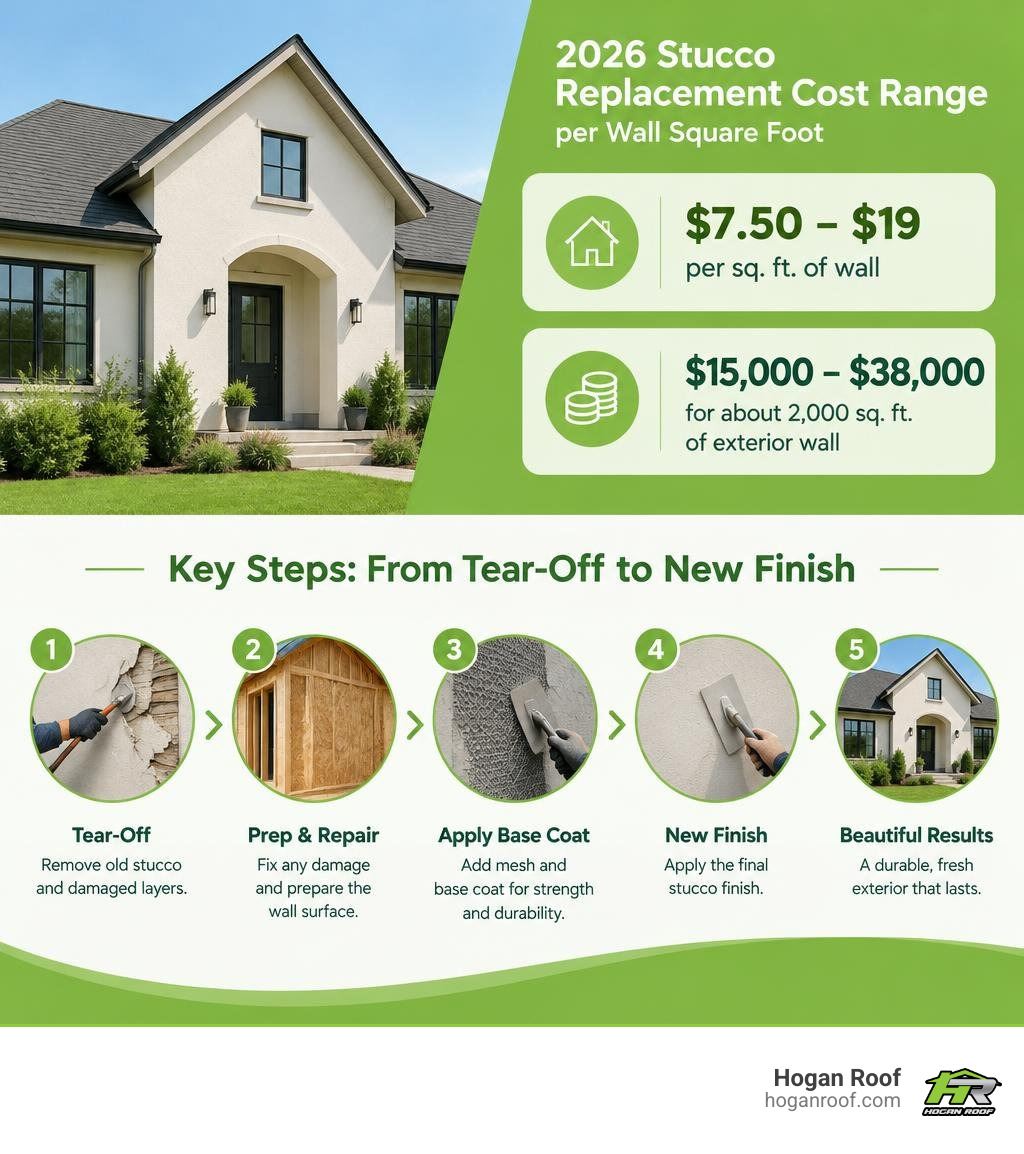
Simple guide to cost to replace stucco terms:
Understanding the Total Cost to Replace Stucco in 2026
When budgeting for a whole-house re-cladding, it helps to break down every step involved. Stucco is a multi-layered masonry exterior, which means replacing it is labor-intensive. The process requires removing the failing materials, inspecting the underlying wood framing or masonry, installing weather-resistive barriers (WRB), securing metal lath, and applying multiple plaster coats.
On average, new stucco materials and application run between $6 and $9 per square foot of wall for traditional cement plaster, as outlined in current stucco cost estimates per sq ft. However, a complete replacement project requires removing the existing failing system first. Demolition and disposal of old stucco typically add $1,000 to $5,000 depending on the wall thickness, site access, and dumpster fees.
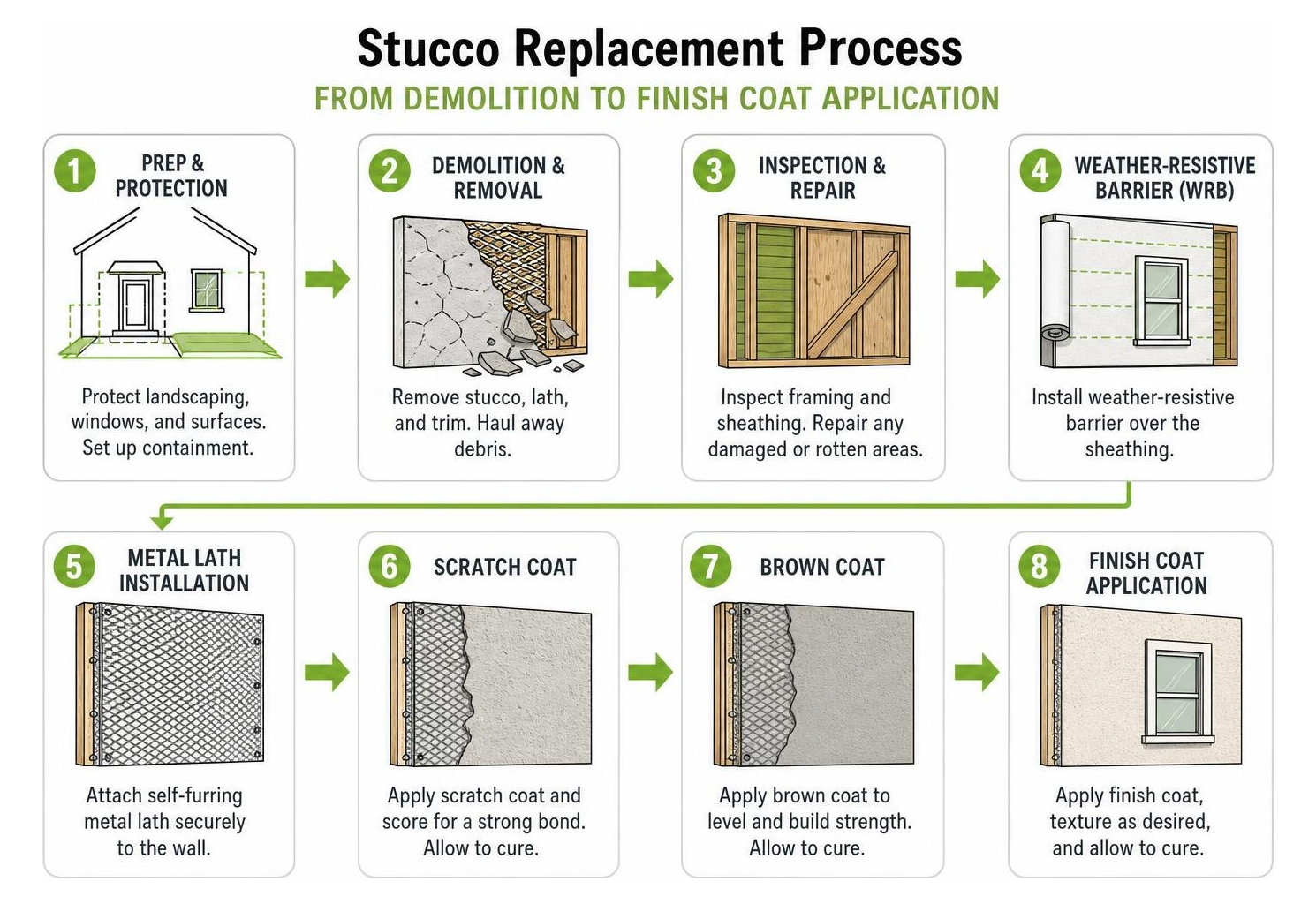
When you combine demolition, substrate repair, and fresh application over a wood frame, the comprehensive cost to replace stucco lands between $7.50 and $19 per square foot of exterior wall surface area.
Average Cost to Replace Stucco by Home Size and Wall Area
Many homeowners make the mistake of estimating their budget using their interior floor plan area. Exterior wall area is what drives project pricing. A two-story home with a 1,500 sq ft floor plan often has significantly more exterior wall area than a sprawling single-story ranch of the same interior size.
Here is what typical whole-house full tear-off and replacement projects look like across different property sizes:
| Home Interior Area | Estimated Exterior Wall Area | Typical Replacement Cost (Traditional Stucco) | Typical Replacement Cost (EIFS Synthetic) |
|---|---|---|---|
| 1,000 – 1,200 sq ft | 1,100 – 1,400 sq ft | $8,500 – $18,000 | $11,000 – $22,500 |
| 1,500 sq ft | 1,500 – 1,800 sq ft | $11,500 – $24,500 | $14,500 – $29,000 |
| 2,000 sq ft | 2,000 – 2,400 sq ft | $15,000 – $34,000 | $19,000 – $38,000 |
| 2,500 – 3,000 sq ft | 2,600 – 3,200 sq ft | $20,000 – $44,000 | $24,500 – $50,000 |
| 3,500+ sq ft (2+ Stories) | 3,500 – 4,500+ sq ft | $27,000 – $60,000+ | $32,000 – $70,000+ |
For a standard 1,500 sq ft home with minimal structural damage, homeowners can expect a ballpark project between $6,000 and $14,500 for single-wall replacements or lighter scopes, while complete tear-offs on multi-story structures scale upward with height and architectural detail.
Regional Cost Variations Across the Country
Where you live plays a significant role in your final estimate. Regional labor availability, climate specifications, and local code enforcement create substantial price variations:
- Sunbelt & Southwest: In states like Arizona, New Mexico, and parts of California, stucco is standard residential construction. Plastering crews are abundant, which keeps labor rates competitive. Traditional installations here frequently sit near the lower end of national averages.
- Northeast & Mid-Atlantic: In our region (New York, New Jersey, and Connecticut), specialized plastering crews are scarcer. Freeze-thaw cycles require heavy-duty water-resistive membranes, drainage planes, and specialized expansion joints to prevent cold-weather cracking. These climate-specific requirements, combined with higher regional labor rates, push quotes 20% to 35% above Sunbelt averages.
- Pacific Northwest & High-Moisture Regions: High annual rainfall demands specialized rainscreen assemblies behind stucco or EIFS systems. Ensuring continuous drainage and capillary breaks adds $1.50 to $3.00 per square foot in material and prep costs.
Key Factors That Influence Stucco Replacement Pricing
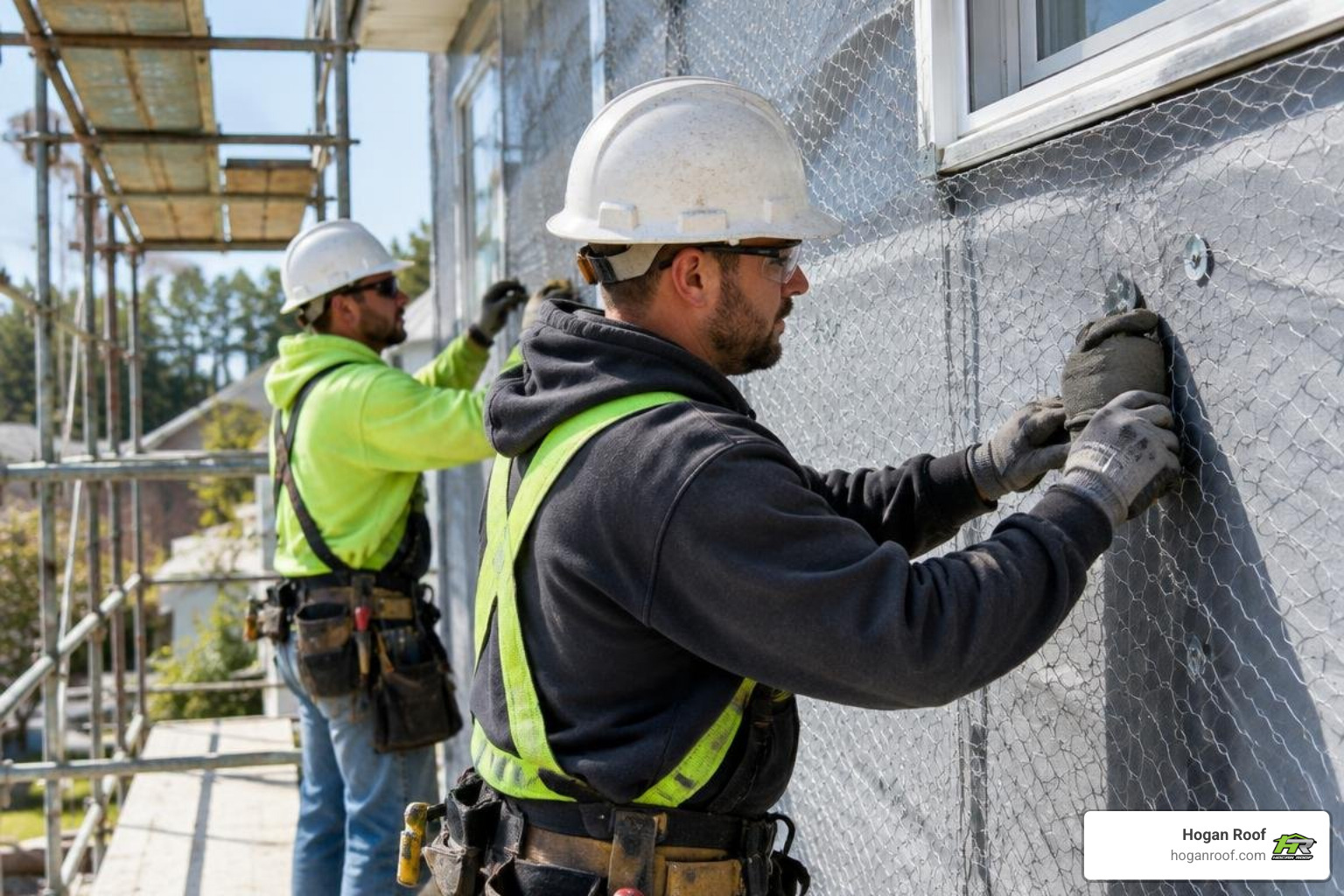
Beyond simple square footage, several structural and logistical variables determine where your estimate falls within our transparent pricing schedules:
- Scaffolding and Height: Multi-story homes, steep roof transitions, and tight property lines require complex scaffolding arrays. Staging a multi-story facade often adds $2,000 to $6,000 to total project labor.
- Architectural Details: Complex curves, pop-outs, decorative bands, quoins, and recessed window returns require manual hand-tooling, which slows installation speed compared to long, unbroken wall spans.
- Site Access and Waste Management: Stucco debris is heavy. Hauling tons of broken concrete, wire mesh, and old tar paper from tight suburban lots requires extra labor time and dedicated disposal containers.
- Local Building Permits and Inspections: Most municipalities mandate building permits for major siding and stucco replacement to verify proper weather barrier flashing. Municipal permit packages typically cost between $250 and $1,200 depending on project valuation.
Substrate Condition, Sheathing, and Water Damage Remediation
The largest financial wildcard in any stucco tear-off project is what lies behind the wire lath. Stucco is porous by nature; when water bypasses failed flashing around windows, doors, or roof intersections, it becomes trapped against the wood sheathing.
As detailed in industry analysis on 2026 stucco replacement cost planning bands, a contractor must address the water source before reapplying cladding. If water has penetrated the wall:
- Plywood or OSB Sheathing Replacement: Rotted sheathing runs $75 to $150 per 4x8 sheet installed.
- Framing Stud and Sill Plate Repairs: Remedying structural rot or insect infestation behind wet walls can add $1,500 to $6,500 depending on structural depth.
- Kickout Flashing and Diverter Installation: Missing roof-to-wall kickout flashings cause thousands of dollars in hidden decay. Correcting these intersections during the project costs $150 to $400 per junction but protects the new wall from repeating the same failure.
Surface Textures and Finish Coats
The final look of your home affects the labor time required for your finish coat:
- Dash / Knockdown Finish: Applied using a hopper gun and lightly flattened with a trowel. It is the most economical texture to apply and hides minor substrate variations effectively.
- Sand / Float Finish: A classic uniform, fine-grained appearance achieved by floating the wet acrylic or cement finish with a sponge.
- Smooth / Santa Barbara Finish: A flat, elegant finish that requires intensive hand-troweling by master plasterers. Because it shows every imperfection, it requires meticulous wall preparation, adding $2.00 to $6.00 per square foot over standard textured finishes.
Stucco System Comparison: Traditional vs. EIFS vs. One-Coat
Choosing the right cladding assembly impacts your upfront budget, energy efficiency, and long-term maintenance needs.
| Feature / Metric | Traditional Three-Coat Stucco | EIFS (Synthetic Stucco) | One-Coat Stucco System |
|---|---|---|---|
| Assembly Layers | Scratch coat, Brown coat, Finish coat over wire lath | Continuous foam board, base coat with fiberglass mesh, synthetic finish | Fiber-reinforced cement base coat, thin finish coat over lath |
| Installed Cost (New) | $6.00 – $9.00 / sq ft | $8.00 – $14.00 / sq ft | $5.50 – $8.50 / sq ft |
| Insulation Value | Low (approx. R-0.2 per inch) | High (R-4.0 to R-6.0 continuous per inch) | Low to Medium (R-1 to R-2 if over thin foam) |
| Impact Resistance | Very High (hard cement shell) | Moderate (can puncture under heavy impact) | High |
| Typical Lifespan | 50 – 80+ Years | 25 – 40+ Years | 30 – 50 Years |
Material Breakdown and How System Types Affect the Cost to Replace Stucco
Traditional three-coat stucco has protected homes for centuries. It relies on a heavy, robust assembly: two layers of asphalt-saturated building paper (or modern house wrap), metal lath, a 3/8-inch scratch coat of cement and sand, a 3/8-inch brown coat, and a decorative 1/8-inch finish coat.
Because each coat must cure before the next is applied, traditional stucco requires multiple days between stages. This curing time adds labor visits, but it creates a hard, fire-resistant shell that can last over 50 years with minimal upkeep.
One-coat stucco systems blend Portland cement with polymers and fiberglass fibers. Applied at roughly 3/8-inch to 1/2-inch thickness directly over rigid foam and lath, it combines the scratch and brown steps into a single pass. While it saves on installation time and upfront labor, it lacks the extreme impact resistance of a true three-coat application.
Synthetic Stucco (EIFS) and Energy Efficiency Value
Exterior Insulation and Finish Systems (EIFS) replace traditional cement base layers with continuous polystyrene insulation boards fastened over the weather barrier, followed by a flexible base coat embedded with fiberglass mesh and a synthetic acrylic finish.
While EIFS costs 15% to 35% more upfront than standard cement plaster, it delivers continuous exterior insulation without thermal bridging. An added continuous insulation layer of R-4 to R-6 per inch helps lower annual heating and cooling bills, allowing homeowners in colder climates to recoup part of their installation costs over a 7 to 12-year window. Modern residential EIFS installations require a dedicated water drainage plane to ensure moisture exits the wall assembly safely.
Repair vs. Resurfacing vs. Full Replacement
Not every failing wall requires complete demolition. Determining whether your home needs a localized fix, a fresh skim coat, or a full tear-off depends on structural soundings and moisture testing.
When Stucco Repair or Re-Dashing Is Sufficient
If your underlying scratch and brown coats are firmly attached to the framing and the wall sheathing is dry, you can save thousands by avoiding full replacement:
- Cosmetic Crack Repairs: Hairline cracks (under 1/16-inch wide) caused by minor settling or thermal shifts can be chased, sealed with elastomeric masonry sealant, and color-matched. Stucco repairs average $1,628 nationally, with most minor crack-chasing jobs ranging from $600 to $2,657.
- Re-Dashing or Skim Coating: If the finish coat is faded, stained, or weathered, but the base coats are solid, a contractor can power wash the facade, apply a bonding agent, and trowel a fresh color-coat over the entire home. Resurfacing typically costs $3.00 to $6.00 per square foot—about one-third to one-half the price of a complete tear-off.
Warning Signs Demanding a Complete Stucco Tear-Off
When deep substrate failures occur, cosmetic repairs only mask problems while wood framing continues to rot behind the wall. A complete tear-off and replacement is necessary when:
- Widespread Delamination: Tapping the wall produces a hollow, drum-like sound across large sections, indicating the stucco has detached from the underlying wire lath.
- Buckling and Bulging Walls: Large sections of plaster are bowing outward. Repairing a 10x10-foot buckled section alone costs $900 to $3,000; when multiple elevations buckle, replacement is the more economical long-term path.
- Persistent Water Intrusion and Staining: Dark streaks beneath window corners or along rooflines that stay damp long after rainfall indicate failed moisture barriers.
- Visible Mold and Musty Interior Odors: Mold growth on interior drywall or framing studs signals that water has saturated the sheathing.
- Damage Exceeding 30% to 50% of the Surface: When half the wall area requires deep structural patching, the cumulative cost of piecemeal repairs exceeds the cost of a clean tear-off and fresh installation.
Alternative Cladding: Replacing Stucco with New Siding Options
When faced with a full tear-off, many homeowners evaluate whether to reinstall stucco or switch to modern siding assemblies. If you want to explore new designs, our team can help you learn how to swap out stucco for sleek new siding.
Comparing Stucco Costs to Vinyl, Fiber Cement, and Engineered Wood
Switching materials during a tear-off project allows you to alter your home's aesthetic while managing future maintenance demands. When considering an exterior overhaul, exploring our complete guide to upgrading your home siding helps weigh these choices side by side:
- Vinyl Siding: Running $4.00 to $12.00 per square foot installed, premium vinyl provides the lowest initial price point and requires virtually zero paint maintenance over its lifespan.
- Fiber Cement (James Hardie): Running $6.00 to $14.00 per square foot installed, fiber cement matches the fire and rot resistance of traditional masonry while offering authentic horizontal lap or vertical board-and-batten aesthetics. It lasts 50+ years with simple repainting every 12 to 15 years.
- Engineered Wood (LP SmartSide): Ranging from $5.50 to $11.00 per square foot, engineered wood provides impact resistance and warm wood grain textures treated to prevent fungal decay.
Frequently Asked Questions About Stucco Replacement
How long does a full stucco replacement project take?
A complete tear-off and replacement on a standard 2,000 sq ft home takes between 1 to 3 weeks of active work , depending on weather and the chosen system:
- Demolition and Substrate Repair (Days 1–3): Stripping old plaster down to the framing, repairing damaged plywood, and hauling away debris.
- Weather Barrier and Lath Installation (Days 3–5): Applying heavy-duty house wrap, weep screeds, window flashings, and self-furring metal lath.
- Scratch and Brown Coats (Days 5–8): Troweling base cement layers and allowing appropriate hydration and cure times.
- Finish Application (Days 8–12): Applying the decorative texture coat, followed by caulking and clean-up.
Do I need a building permit to replace stucco?
Yes. While minor hairline crack patching does not require municipal oversight, a full tear-off and replacement alters your home's weather-resistive envelope and requires a building permit in almost every jurisdiction. Building inspectors must verify that weep screeds are set at the proper clearance above grade and that window and door flashings comply with current moisture protection codes.
Can I save money on stucco replacement without sacrificing quality?
Yes. You can manage your project budget by:
- Scheduling During Shoulder Seasons: Booking your exterior work during early spring or late autumn when contractor schedules are less congested can yield better labor rates.
- Selecting Standard Textures and Factory Colors: Custom smooth trowel finishes and custom pigment formulas add thousands in specialist labor. Choosing a classic sand or knockdown finish keeps labor costs predictable.
- Repairing Substrates Selectively: Replace rotted sheathing only where moisture testing indicates damage rather than unnecessarily stripping sound, dry plywood.
- Utilizing Project Financing: Spreading the expense over structured monthly plans helps you fund correct weatherproofing and flashing up front. Learn more about our flexible financing options to plan your exterior renovation comfortably.
Conclusion
Replacing your home's stucco exterior is a major investment that protects your property from severe weather while restoring curb appeal. Addressing damaged cladding early prevents hidden structural rot and ensures your home remains energy efficient for decades.
At Hogan Roof, we bring over 20 years of exterior remodeling experience as an Owens Corning Platinum Preferred Contractor across New York, New Jersey, and Connecticut. Whether your property needs a full tear-off, professional leak diagnosis, or an upgrade to modern cladding, our team delivers honest evaluations, clear pricing, and craftsmanship built to last.
Contact us today to schedule your free inspection and explore our full range of professional siding services.