Don't Get Nailed: How to Estimate Your Roof Replacement Cost
Start Your Roof Replacement Estimate With the Right Area
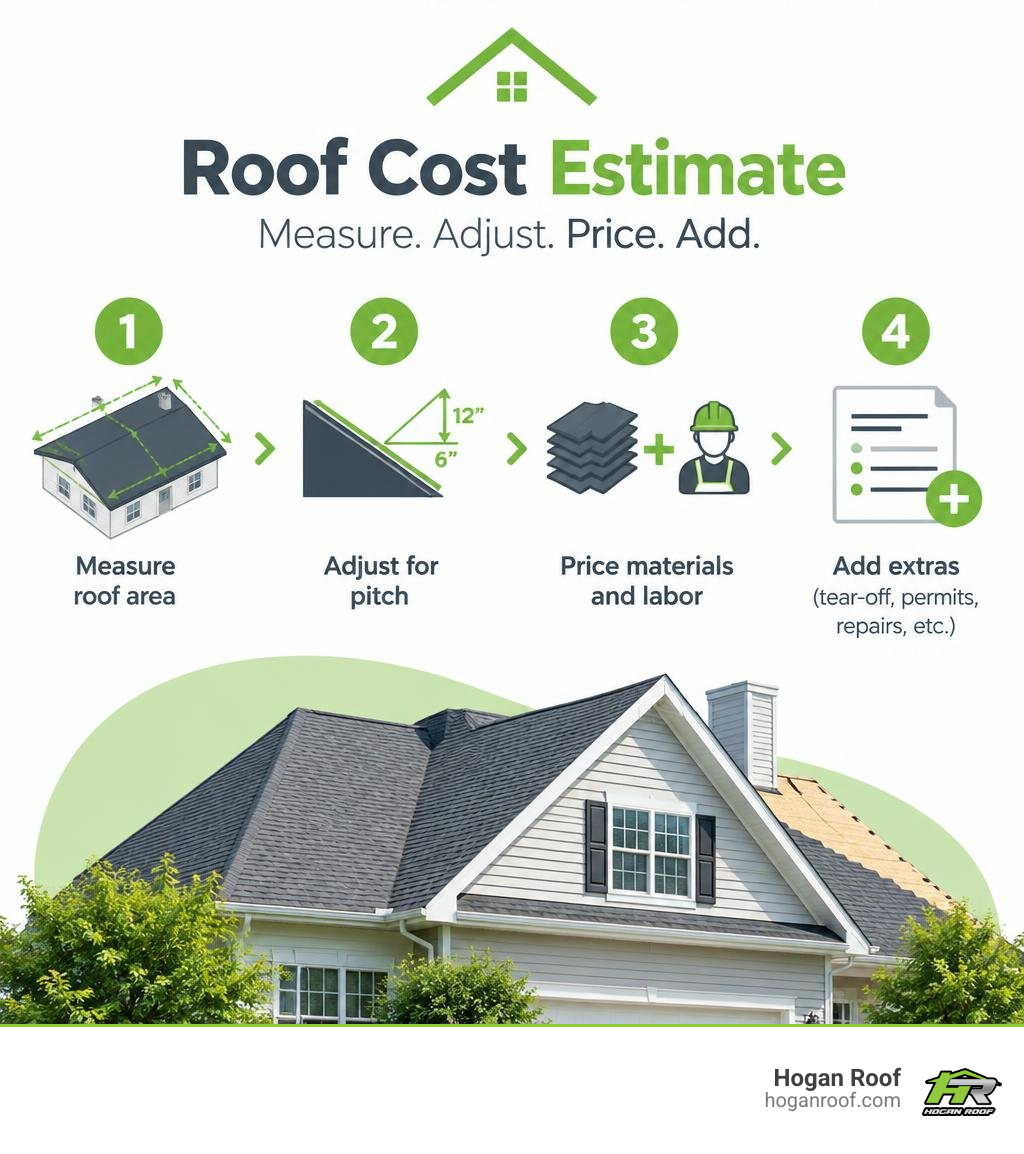
To estimate your roof replacement cost, start with the roof's surface area, not just your home's square footage. Multiply the area beneath each roof section by its pitch factor, then multiply the total by an installed price per square foot for your chosen material. Add costs for tear-off, permits, and any needed decking or flashing repairs. Allow another 10% to 15% of the roof area when estimating materials for cuts and waste.
In 2026, a U.S. roof replacement averages roughly $9,500 to $9,800 , but your quote may differ sharply based on material, roof shape, and local labor costs. The steps below will help you build a useful budget before comparing bids.
I'm Bill Hogan, owner of Hogan Roof. After more than 20 years serving homeowners across NY, NJ, and CT, I know a reliable roof replacement estimate starts with clear measurements and a complete scope of work.
Roof replacement estimate word list:
How to Calculate Your Roof Replacement Estimate: Step-by-Step
Calculating your roof replacement cost starts with understanding your home's geometric footprint. Many homeowners make the mistake of using their interior living space as the direct roof measurement. However, a 2,000-square-foot two-story home has a foundation footprint of only 1,000 square feet, while a single-story ranch of the same interior area has a full 2,000-square-foot base.
To determine your baseline area:
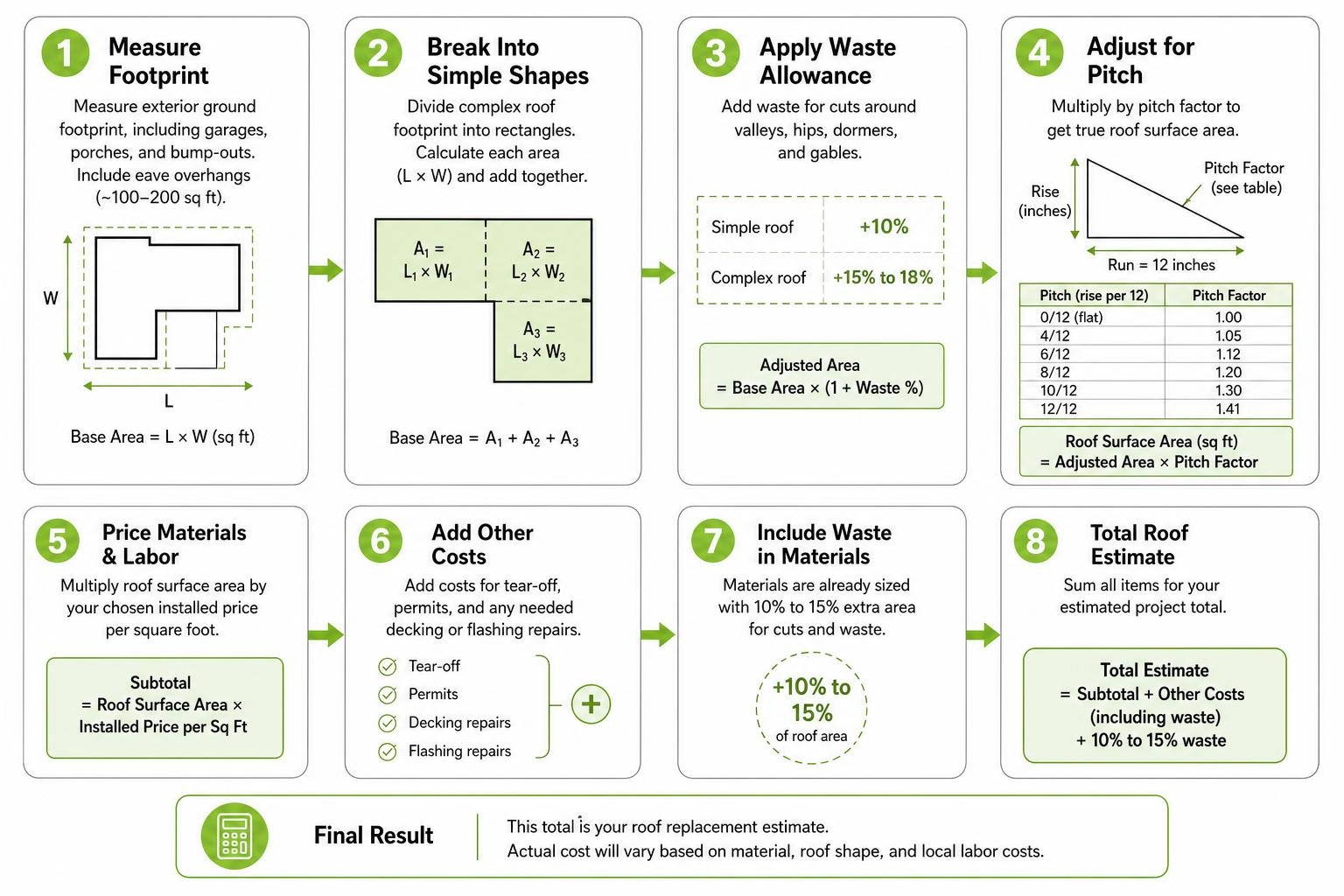
- Measure your exterior ground footprint : Measure the exterior length and width of your home's foundation, including attached garages, porches, and bump-outs.
- Break complex shapes into simple rectangles : If your home is L-shaped or T-shaped, divide it into basic geometric sections, calculate the area of each (Length × Width), and add them together.
- Include eave and rake overhangs : Most residential roofs extend 1 to 2 feet past exterior walls. Add roughly 100 to 200 square feet to your baseline footprint to account for these perimeter overhangs.
- Factor in the waste margin : Roofing materials require cutting around valleys, hips, dormers, and gables. For a simple gable roof, add a 10% waste factor. For complex roofs with multiple intersecting valleys and dormers, budget for a 15% to 18% waste overage.
You can verify your rough initial math by cross-referencing industry tools like the Roof Replacement Cost Calculator 2026 to ensure your square footage benchmarks match modern standards.
Pitch Correction and Area Math for an Accurate Roof Replacement Estimate
Roof slope—known in the construction trade as "pitch"—has a dramatic effect on your actual surface area. Pitch is expressed as the number of inches a roof rises vertically for every 12 inches it extends horizontally (e.g., 6/12 pitch). Because angled planes have a larger surface area than flat planes, you must multiply your base ground footprint by a pitch correction multiplier.
To find the pitch correction multiplier, take the roof's rise (in inches per 12 inches of horizontal run), divide it by 12, square that result, add 1, and then take the square root of the total. For example, a 6/12 pitch gives you (6 ÷ 12) squared = 0.25, plus 1 = 1.25, and the square root of 1.25 is about 1.118.
| Roof Pitch | Slope Description | Pitch Multiplier | Example: 2,000 sq ft Footprint Actual Area |
|---|---|---|---|
| 2/12 to 3/12 | Low Slope | 1.014 – 1.031 | 2,028 – 2,062 sq ft |
| 4/12 to 5/12 | Moderate Walkable | 1.054 – 1.083 | 2,108 – 2,166 sq ft |
| 6/12 to 7/12 | Standard Residential | 1.118 – 1.158 | 2,236 – 2,316 sq ft |
| 8/12 to 9/12 | Steep Pitch | 1.202 – 1.250 | 2,404 – 2,500 sq ft |
| 10/12 to 12/12 | Mansard / High Pitch | 1.302 – 1.414 | 2,604 – 2,828 sq ft |
| 24/12 | Extreme A-Frame | 2.236 | 4,472 sq ft |
In the roofing trade, materials and labor are priced in "squares." One roofing square equals exactly 100 square feet of roof surface. For example, a 2,000-square-foot footprint with a 6/12 pitch yields 2,236 square feet of actual roof surface. Adding a standard 15% waste factor brings the total material order to 2,571 square feet, or roughly 26 roofing squares (which translates to 78 shingle bundles, as three bundles cover one square).
To visualize how different shingle styles and profiles look against your home's specific geometry, try out an interactive roof designer tool to map materials directly to your home's architectural lines.
Cost Breakdown by Roofing Material and Square Footage in 2026
Material selection is the primary driver of your upfront investment, dictating between 30% and 40% of the gross contract value. While traditional asphalt shingles remain the standard across suburban neighborhoods, architectural upgrades, metal panels, synthetic composite tiles, and natural slate offer distinct balances of curb appeal, weather resistance, and service lifespans.
| Roofing Material | Cost per Sq. Ft. (Installed) | Total Cost for 2,000 Sq. Ft. Home | Expected Lifespan | Key Performance Benefits |
|---|---|---|---|---|
| 3-Tab Asphalt Shingles | $3.40 – $4.50 | $6,800 – $9,000 | 15 – 22 Years | Entry-level budget option, basic wind resistance. |
| Architectural Shingles | $4.25 – $6.40 | $8,500 – $14,000 | 25 – 30 Years | Multi-layered dimensional profile, high wind resistance. |
| Standing-Seam Metal | $9.00 – $16.00 | $18,000 – $32,000 | 40 – 70 Years | Concealed fasteners, superior snow shedding, fireproof. |
| Clay / Concrete Tiles | $10.00 – $18.50 | $20,000 – $37,000 | 50 – 100 Years | Exceptional thermal resistance; requires heavy framing. |
| Natural Slate | $23.00 – $34.00 | $46,000 – $68,000 | 75 – 150+ Years | Impervious to rot, maximum historic curb appeal. |
For deep insights on how regional climate shifts and localized supply chains impact regional material rates, review our analysis on location-based material pricing.
Roof Size Pricing Tiers (1,500 to 3,000 Sq Ft)
Total installation prices scale according to home surface area, roof complexity, and structural stories:
- 1,500 Sq. Ft. Home (16–19 Squares Installed) : Architectural asphalt ranges from $7,000 to $12,500 , whereas standing-seam metal runs $14,500 to $24,000 .
- 2,000 Sq. Ft. Home (22–26 Squares Installed) : Architectural asphalt averages $8,800 to $15,500 , while premium tile or metal spans $20,000 to $35,000 .
- 2,500 Sq. Ft. Home (28–33 Squares Installed) : Architectural asphalt averages $11,500 to $19,500 , and high-end materials reach $28,000 to $48,000 .
- 3,000 Sq. Ft. Home (34–40 Squares Installed) : Architectural asphalt costs $14,500 to $24,500 , with natural slate or standing-seam metal ranging from $35,000 to $70,000+ .
To understand where your project falls within localized economic spectrums, compare baseline figures through the Roof Replacement Cost Calculator Band Guide.
Key Labor, Tear-Off, and Hidden Line-Item Costs
Labor comprises 50% to 60% of a professional roofing invoice. Certified roofers typically command billing rates of $40 to $90 per hour per crew member, with specialized lead mechanics charging roughly $130 per hour.
Removing your existing roof covering costs between $0.40 and $2.00 per square foot ($665 to $3,343 for typical residential structures). This cost covers manual tear-off, ground protection, magnetic nail sweeping, dumpster rental fees, and landfill tipping charges (which range from $40 to over $120 per ton depending on municipal waste regulations).
Reading Line Items on a Roof Replacement Estimate
A professional contract must provide an itemized breakdown rather than a single lump sum. Essential line items include:
- Synthetic Underlayment : Replaces obsolete organic felt paper with high-traction, water-repellent polymers ($1.50 to $2.10 per sq ft installed).
- Ice & Water Shield : Self-adhering modified bitumen membrane installed along eaves, valleys, rakes, and low-slope transitions to defend against freeze-thaw cycles and ice dams ($1.87 to $2.53 per sq ft).
- Drip Edge & Gutter Aprons : Corrosion-resistant metal perimeter flashing that guides water runoff cleanly away from fascia boards and into gutters ($2.00 to $4.00 per linear foot).
- Plumbing Pipe Boots & Roof Penetrations : Heavy-duty EPDM or silicone collar boots sealing vent stacks ($63.00 to $85.00 each).
- Municipal Permits : Local building department filing fees, safety compliance reviews, and inspector sign-offs ($150 to $600+).
Choosing a comprehensive residential roofing package guarantees that all essential accessory materials come from matched manufacturing systems, protecting your lifetime warranty.
Decking Repairs, Flashing, and Ventilation Upgrades
Contractors cannot fully assess the structural wooden sheathing until all existing layers are stripped. If previous leaks caused wood rot or delamination, damaged sheets must be replaced. Replacement CDX plywood or OSB sheathing averages $2.20 to $3.00 per square foot ($65 to $95 per 4x8 sheet, installed).
Chimney and sidewall flashing represent another critical area. Ripping out corroded lead or copper step flashing and installing new counter-flashing into masonry mortar joints runs $9.00 to $11.00 per linear foot .
Continuous ridge ventilation paired with intake soffit vents ($2.80 to $5.28 per linear foot) balances attic temperatures, prevents winter moisture buildup, and protects shingles from premature heat aging. Once installation is complete, you can follow our thorough post-installation check to verify that all critical flashing steps and ventilation criteria were performed correctly.
Repair vs. Replace: Deciding When Your Roof Is Done
Deciding between targeted patch repairs and a full tear-off comes down to roof age, the extent of the damage, and overall cost:
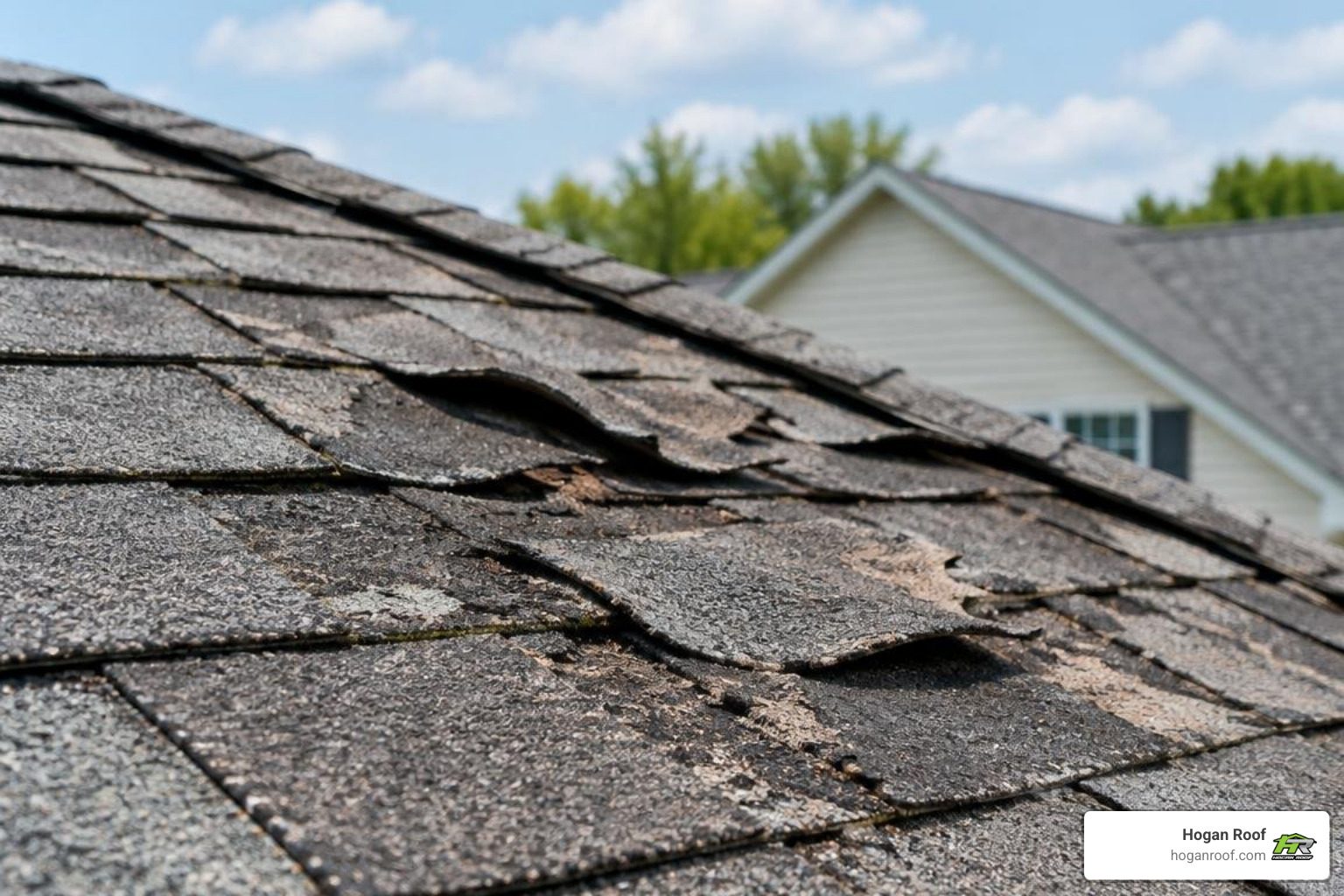
- The 20-Year Milestone : Traditional 3-tab shingles exceeding 18 to 20 years of service lose their protective mineral granules, leaving the underlying fiberglass mat vulnerable to UV rays and brittle cracking.
- The 30% Economic Rule : If repairing localized storm damage or flashing failures costs more than 30% of a full replacement, a complete tear-off is typically the more cost-effective long-term choice.
- Granule Loss & Shingle Curling : Granules accumulating in your gutters, along with cupped, curling, or clawing shingle tabs, indicate that the asphalt binder has dried out.
- Structural Sagging & Interior Leaks : Depressions in the roofline or persistent attic moisture suggest deeper rot in the rafters or sheathing that simple patches cannot solve.
Booking a professional roof inspection provides an objective assessment of your roof's condition, while keeping up with routine roof maintenance helps extend the life of your existing shingles until you're ready for a replacement.
Strategic Ways to Lower Your Roofing Costs and Secure Financing
A roof replacement is a major home investment, but there are several practical ways to manage your project budget:
- Plan for Off-Peak Seasons : Roofing demand peaks between late summer and mid-autumn. Booking during late winter or early spring (Q1) can help you secure off-season labor discounts of 5% to 12%.
- Collect Three Itemized Bids : Request three detailed, written proposals from licensed and insured contractors. Be wary of bids that come in significantly below market value, as they often leave out essential costs like tear-off, dump fees, or permit applications.
- Invest in System Warranties : Working with certified manufacturer-backed installers (such as Owens Corning Platinum Preferred contractors) grants access to extended 50-year non-prorated workmanship warranties, eliminating future repair costs.
- Avoid Shingle Layering (Overlays) : Laying new shingles directly over old ones might save you $1,000 to $2,500 on tear-off costs today, but it traps heat, prevents deck inspections, voids many manufacturer warranties, and increases the cost of your next replacement down the road.
Review our guide to transparent project pricing to see how clear, itemized scopes help prevent surprise change orders during installation.
Financing and Flexible Payment Solutions
If your roof project isn't covered by an active insurance claim, flexible financing options can help spread out the investment over time:
- Contractor Promotional Financing : Many factory-certified contractors offer 12- to 24-month zero-interest or reduced-rate promotional plans through specialty lenders.
- Home Equity Lines of Credit (HELOC) : A home equity line of credit provides a cost-effective, tax-deductible borrowing option with competitive interest rates for major home renovations.
- Fixed-Rate Personal Home Improvement Loans : Unsecured personal loans offer fast approvals and predictable monthly payments without requiring home equity as collateral.
Explore our flexible financing plans to find low-monthly-payment options that fit your household budget, or use our guide on planning major home project loans to calculate payments based on current interest rates.
Frequently Asked Questions About Roof Replacement
How much does a typical roof replacement cost in 2026?
The national average cost to replace an asphalt shingle roof on a standard single-family home in 2026 is approximately $9,800 , with most homeowners spending between $5,800 and $18,000 . Overall project totals vary based on surface square footage, roof pitch, local disposal fees, and material choice (ranging up to $35,000+ for standing-seam metal and $68,000+ for natural slate).
Does homeowners insurance cover the full cost of roof replacement?
Homeowners insurance typically covers roof replacements resulting from sudden, accidental weather perils—such as severe hail strikes, fallen tree limbs, or high-wind blow-offs—minus your policy deductible. Standard policies do not cover normal wear, age-related deterioration, or long-term maintenance issues. Coverage payouts depend on whether your policy pays Replacement Cost Value (RCV) , which covers modern replacement costs, or Actual Cash Value (ACV) , which deducts for depreciation based on the age of your roof.
How many roofing quotes should I get before choosing a contractor?
You should obtain three written quotes from licensed, insured local contractors with physical offices and verified customer references. Make sure each quote outlines an identical scope of work—including the shingle brand, underlayment type, ice barrier coverage, ventilation upgrades, warranty terms, and cleanup procedures. This makes it easy to compare bids directly and spot any low estimates that cut corners on materials or labor.
Conclusion
Understanding your roof's measurements, pitch multipliers, material options, and accessory requirements helps you build an accurate roof budget and evaluate contractor proposals with confidence. Clear line-item estimates ensure your home receives lasting weather protection without unexpected costs along the way.
Ready to price your project with a certified team? Contact Hogan Roof today to schedule your comprehensive on-site inspection or explore our full range of expert roofing services across New York, New Jersey, and Connecticut.